New Puppy Training: A Flexible First Four Weeks
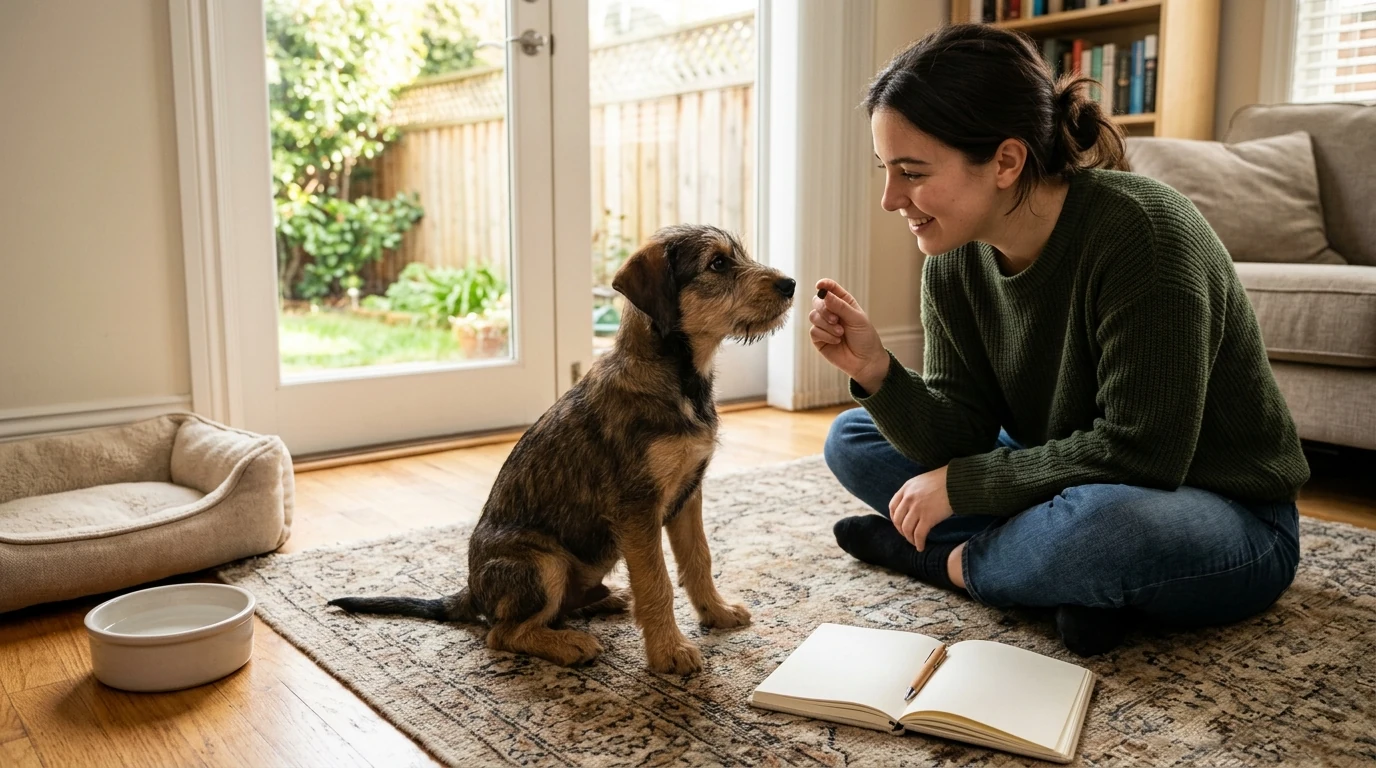
Bringing home a puppy is exciting, but the first days can blur together: potty trips, meals, play, naps, and the occasional mystery puddle. You do not need to teach every command right away. Start with a routine your household can repeat, reward the behaviors you want to see again, and leave room for your puppy to rest. Our New Puppy Training Starter Guide is a printable eBook built to help beginners organize those first four weeks.
Start with the routine, not a long list of commands
For the first few days, focus on three questions your puppy is learning to answer: Where do I go potty? Where can I settle? What usually happens next? A consistent sequence—wake up, go outside, eat, play, rest—is more useful than a rigid clock-based schedule that ignores your puppy’s needs.
Take your puppy to their designated potty spot after waking, eating, drinking, and playing. When they go there, praise and reward them promptly so the connection is clear. Between those trips, you can fit in tiny moments of training: say their name, reward a glance toward you, or practice one easy cue. Stop while the interaction is still fun.
| Week | Main focus | Simple daily practice |
|---|---|---|
| 1 | Settle in and establish potty habits | Use the same potty spot, reward success, and practice responding to their name. |
| 2 | Build predictable routines | Continue potty trips and introduce brief, reward-based practice with one basic cue. |
| 3 | Practice in everyday settings | Repeat familiar cues around mild distractions and introduce new experiences at your puppy’s pace. |
| 4 | Strengthen what is working | Keep rewarding reliable habits and adjust the routine where your puppy still needs help. |
These weeks are a framework, not a deadline. If your puppy needs more time with a skill, keep practicing it. You can add the next step when the current one feels comfortable.
Make house-training easier to repeat
Choose a potty spot and visit it regularly, especially at those natural transition points in the day. Supervise your puppy indoors when you can. Circling, sniffing, or suddenly wandering away may be your cue to make another trip outside. The American Kennel Club’s puppy potty-training guidance also emphasizes consistency, supervision, and rewarding success.
Accidents are information, not a reason to scold. Clean up, consider whether the last interval was too long, and try an earlier trip next time. Punishment cannot show your puppy where you want them to go; a well-timed reward at the right spot can.
For a few days, jot down meals, naps, potty trips, and accidents. You may notice that a trip is often needed sooner after play or that one part of the day requires closer supervision. A short household record helps everyone respond to the same pattern instead of guessing.
Teach useful cues one small step at a time
Begin with attention. In a quiet room, say your puppy’s name once. When they look toward you, reward them. That simple exchange makes it easier to introduce other cues because your puppy has practiced turning to you first.
Next, try a cue such as “sit” or “come” in a low-distraction space. Reward the action you want, do a few successful repetitions, and return to it later. If your puppy loses interest, the session has probably gone on long enough. Brief practice woven through the day is easier to maintain than one long lesson.
Agree on cue words with everyone who cares for your puppy. If one person says “come” while another uses a different word for the same action, learning becomes less clear. Our team favors a short list of shared cues over a crowded training checklist: decide what you will say, what you will reward, and where you will practice first.
Approach socialization with care
Socialization means helping your puppy build positive associations with people, sounds, surfaces, gentle handling, and appropriate environments. It does not mean meeting every person or dog you encounter. Let your puppy observe something new from a comfortable distance, and pair the experience with treats or play. If they seem frightened, add distance or pause.
Ask your veterinarian which outings and interactions are appropriate for your puppy’s health and vaccination status. For more background on humane, reward-based training and early experiences, see the American Veterinary Society of Animal Behavior’s position statements. Controlled, positive introductions give you more opportunities to notice how your puppy is coping than an overwhelming outing does.
Keep a plan the whole household can use
Put your routine where everyone can see it, along with your agreed cue words and the reward behaviors you are working on. Update it when your puppy’s patterns change. If keeping household tasks organized is difficult, our Finally Focused workbook offers time-management tools for you; it is not a puppy-training guide.
For the puppy-specific steps, use our printable New Puppy Training Starter Guide as a starting framework for a four-week routine, house-training, commands, and socialization. Adapt its daily practice to your puppy and your veterinarian’s advice. Progress will not look identical every day. Notice what your puppy can do comfortably, repeat it, and build from there.
FAQ
What is the first thing I should train my new puppy?
Start with a predictable potty routine and reward your puppy for using the designated spot. You can also reward them for looking toward you when you say their name.
How long should puppy training sessions be?
Keep sessions brief, positive, and suited to your puppy’s attention span. A few successful repetitions throughout the day are more useful than continuing after your puppy loses interest.











Leave a comment