4-Week At-Home Workout Plan: Minimal Equipment PDF
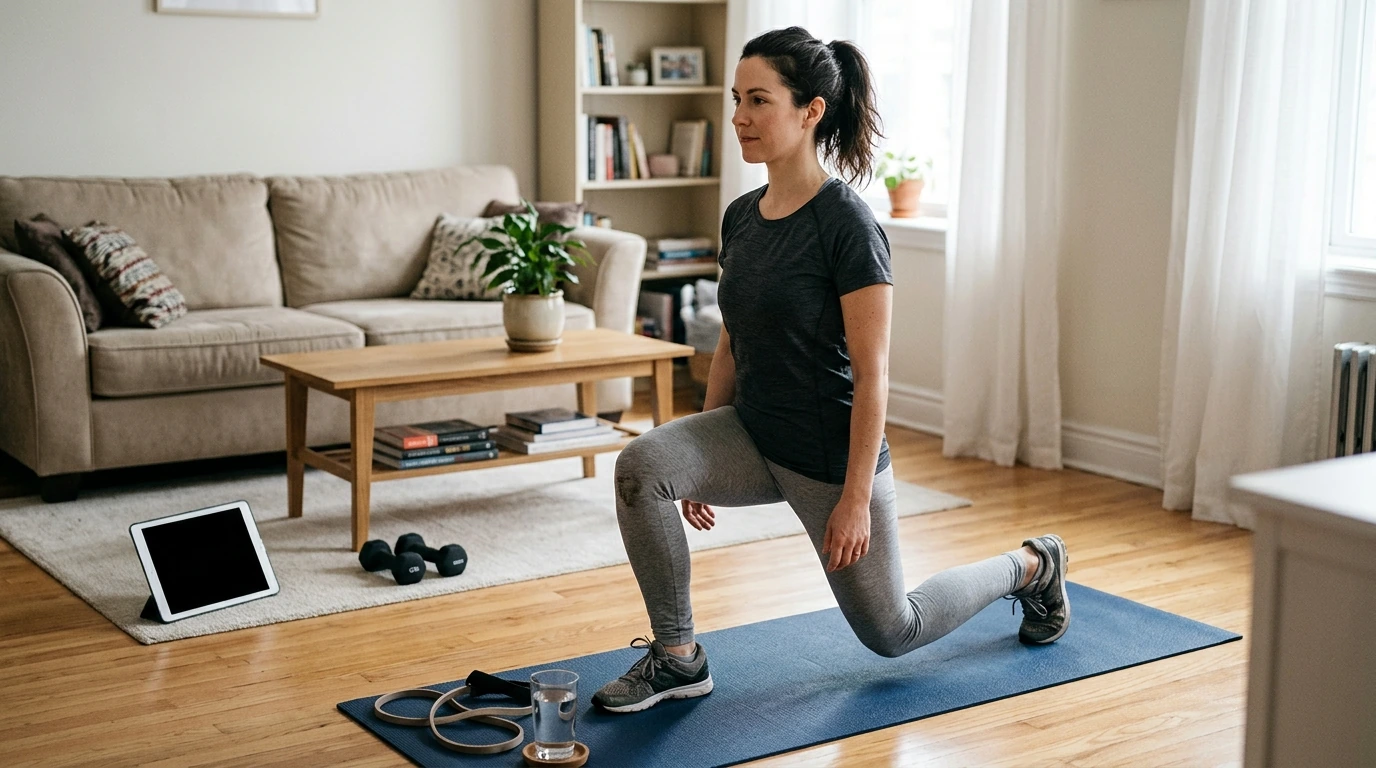
Fit at Home: A 4-Week, Minimal-Equipment Routine That Actually Fits Real Life
Consistency gets easier when the plan is already done. Our team built Fit at Home as a 4-week workout schedule for small spaces, busy days, and minimal gear—so you’re never stuck wondering what to do next. You’ll follow daily structure (strength, light cardio, mobility, and stretching) that supports steady progress while keeping your body feeling better week after week.
If you want a routine that’s realistic enough to repeat—even on imperfect days—this is the kind of plan that helps you stack wins instead of starting over.
Who this 4-week plan is built for
- If you want a clear daily routine without needing a gym membership
- If you’re a beginner who wants guided workouts and stretch sessions that feel approachable
- If you’re returning after a break and need a manageable ramp-up
- If you exercise at home with limited space and limited equipment
- If you do best with a day-by-day checklist instead of freestyle workouts
Because the schedule is already mapped, you can put your energy into showing up, moving well, and building momentum—rather than designing workouts from scratch.
What’s inside the Fit at Home PDF (and how to use it)
Our Fit at Home: 4-Week Workout Plan (PDF) is designed to reduce decision fatigue: you open the plan, do the day, and move on with your life.
- A 4-week calendar-style plan with daily workouts and stretches
- Minimal equipment focus: start with bodyweight, then optionally add a mat, resistance band, or light dumbbells if you have them
- Clear daily intent so each session has a purpose (strength, mobility, recovery, or a balanced mix)
- A “best results” approach that prioritizes repeatability: schedule a consistent time, keep sessions short, and track completed days
- A practical habit tip: choose a default “Plan A” time plus a 10–15 minute “Plan B” window so busy days still count
For general health, major guidelines recommend a blend of weekly activity that includes aerobic movement plus muscle-strengthening work. If you like having a north star, you can review the basics from the CDC and the American College of Sports Medicine (ACSM).
Minimal equipment, maximum momentum: what you need (and what helps)
You don’t need a home gym. You need a small clear space, something comfortable to wear, and a plan you’ll actually repeat. Shoes are optional (some people prefer barefoot for stability), and water is non-negotiable.
| Item | Why it helps | Optional swap |
|---|---|---|
| Mat or towel | Cushions knees and supports floor work | Folded blanket |
| Resistance band | Adds scalable resistance for strength moves | None (use tempo/pauses instead) |
| Light dumbbells | Simple strength progressions without complex setup | Filled water bottles |
| Timer | Keeps intervals consistent and removes guesswork | Clock with a seconds hand |
| Chair/bench | Useful for step-ups, incline moves, and support | Sturdy couch edge |
If you’re not adding gear, you can still progress by increasing reps, slowing the tempo, adding pauses, shortening rest, or doing one extra round. Those “small levers” add up fast—without making your workouts feel chaotic.
How the 4 weeks build results without burning out
- Week 1: Establish form, rhythm, and a baseline—your main job is showing up and moving well.
- Week 2: Gently increase volume (a few more reps or rounds) while keeping recovery realistic.
- Week 3: Add intensity through structure (slower lowering, shorter rests, tighter sets) rather than pushing to exhaustion.
- Week 4: Consolidate progress with steady sessions and consistent stretching so you finish stronger, not depleted.
- Built-in balance: Pairing workouts with mobility and stretches supports joints, posture, and day-to-day comfort.
This pacing matters: you’re not trying to “win” one workout—you’re building a month of follow-through.
A simple weekly rhythm (example structure you can expect)
Most people stay consistent when the week has a predictable flow. You’ll see a repeating rhythm like strength days, mobility + stretch sessions, light conditioning, and real recovery.
- Strength days: Repeatable movement patterns that don’t require machines
- Mobility + stretch days: Hips, shoulders, and back work that supports better movement
- Light conditioning: Raise your heart rate without turning it into a suffer-fest
- Recovery counts: Rest days protect your consistency beyond the first motivation spike
- If you miss a day: Resume the next scheduled day—don’t double up
Make it your plan: quick modifications for beginners, intermediates, and busy days
If follow-through is your biggest hurdle, pairing this routine with a focus system can help. Our team also stocks Finally Focused: The Anti-Procrastination Workbook, which is built around practical structure and time-management tools you can apply to your training schedule, too.
Grab the Fit at Home PDF and start with Day 1
If you’re ready for a plan that removes guesswork, start here: Fit at Home: 4-Week Workout Plan | Minimal Equipment Exercise Guide PDF. Download it, pick a start date, and commit to completing Week 1 without overthinking. Once you’re in motion, the rest gets easier.
FAQ
What is fit at home?
Fit at Home is a structured 4-week at-home workout plan delivered as a PDF, designed for minimal equipment and small spaces. You’ll follow daily sessions that combine strength, light conditioning, mobility, and stretching so you can stay consistent without guessing what to do next.
Do results require equipment or a lot of space?
No—this routine is built to work in a small, clear area using bodyweight first. If you want extra options, a mat, resistance band, or light dumbbells can help, but you can progress by adjusting reps, tempo, rest time, and rounds.
What if a day gets missed—should the plan restart?
You don’t need to restart; just pick up with the next scheduled day and keep going. If time is tight, do a short “minimum session” (warm-up, one circuit, quick stretch) so you protect momentum.












Leave a comment